
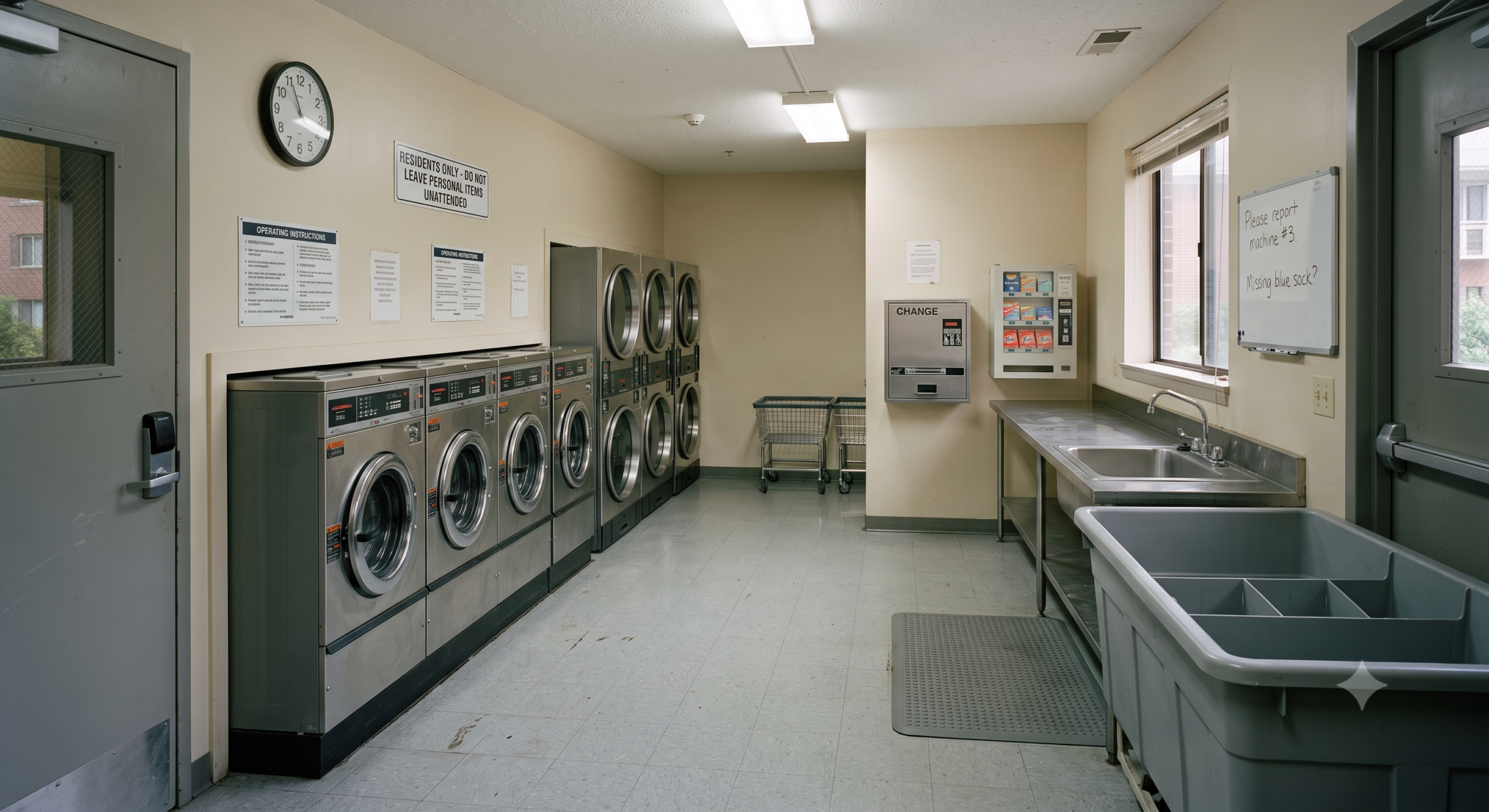
As a property manager at an apartment complex, you probably don’t think about your laundry room until a tenant complains about a broken machine. The truth is, your laundry room is one of the most used spaces in your complex, and you need the right setup to keep it moving efficiently.
From examining your resident profile to working with the right installation team and machines, here’s a look at how you can choose the perfect laundry room setup for your community.
Start With Your Resident Profile
Young professionals have different laundry habits than large families or senior citizens. Knowing your residents is the first step to selecting the perfect machines, capacity, and payment preferences for your laundry room. Let’s break down the profiles:
- Young professionals: Smaller loads, less often, desire app-based payments and alerts
- Families: More loads per week at large capacities. Machines should handle bedding and children’s clothing
- Senior residents: Simple controls, top-load washer preferences
Occupancy type shapes the math too. A 100-unit building of single-occupant studios uses laundry differently than a 100-unit building of three-bedroom apartments. Average household size and laundry frequency inform every other decision in this process.
Calculating the Right Machine-to-Resident Ratio
There’s no universal formula, but practical guidelines exist. A common starting point is one washer and one dryer for every 8 to 12 units. That ratio shifts based on household size, unit type, and whether some residents have in-unit hookups.
Peak hours create the real test. Most shared laundry rooms see their heaviest traffic on weekend mornings and weekday evenings. If machines are running at capacity during those windows and residents are standing around waiting, your ratio is probably off.
The warning signs are worth watching:
- Machine wear that outpaces expected service life usually signals overuse
- Ongoing complaints about wait times point to the same problem
- On the flip side, low usage often means outdated equipment, inconvenient access, or payment options that don’t fit residents’ habits.
Each signal is worth investigating before spending money on new equipment.
Washer and Dryer Capacity: Bigger Isn’t Always Better
Large-capacity machines seem like the obvious answer. More cubic feet means fewer loads. In practice, it’s more complicated. A 5.0 cubic foot washer in a building full of studio apartments will run partial loads all day. That wastes water, energy, and machine cycles.
Standard-capacity machines, around 3.0 to 3.5 cubic feet, handle everyday loads efficiently. Large-capacity units, 4.5 cubic feet and up, make sense for family housing or properties where residents regularly wash comforters, rugs, and large items.
Utility costs are part of this math. High-capacity machines use more water and energy per cycle. In Texas, water rates vary by city and summer utility costs can climb quickly. Matching machine size to actual load habits keeps those costs in check without leaving residents short on capacity when they need it most.
Single-Load vs. Multi-Load Machine Mix
One common mistake is filling a laundry room with identical machines. Mixed-capacity setups usually perform better. Residents have different needs, and a room that handles a quick single load and a full family wash at the same time serves more people without creating traffic jams.
- For smaller properties with 20 to 40 units, two or three standard washers with matching dryers often cover demand.
- Mid-size properties with 40 to 80 units benefit from a mix of standard and large-capacity machines.
- Larger communities of 80-plus units may need dedicated high-capacity equipment alongside standard units to move traffic during peak hours.
The right mix comes from knowing your residents and your peak patterns. A site walkthrough and basic usage analysis will tell you more than any rule of thumb. An experienced equipment partner can help you read those signals and configure a room that performs.
Laundry Room Layout and Space Planning
Traffic flow matters. Residents should be able to move between machines, folding counters, and the door without crossing paths. A straightforward layout, machines on one or two walls with folding space in the center or along a third wall, handles most floor plans well. Wider aisles reduce congestion during busy periods.
Lighting and basic comfort matter more than most people expect. Bright overhead lights, clean floors, and a place to sit while waiting all signal that the property cares about the space. A laundry room that feels safe and functional gives residents one less reason to look for an apartment with in-unit hookups.
Payment System Options
Coin-only laundry rooms are becoming a growing source of friction. Younger residents often don’t carry quarters. Stopping at a change machine before doing laundry is an extra step they don’t want.
Card and mobile payment options remove that barrier. App-based systems let residents check machine availability, start cycles remotely, and receive alerts when their load finishes. That cuts down on office calls considerably. Staff spend less time answering laundry questions.
Energy and Water Efficiency Considerations
High-efficiency commercial machines sometimes carry a higher equipment cost. Over time, they generate real savings on utility bills. Lower water consumption and shorter cycle times add up across hundreds of loads per month. That math matters in Texas, where summer temperatures push cooling costs up, and water rates vary across cities and water districts.
The EPA’s ENERGY STAR program provides useful benchmarks. Commercial Speed Queen machines are built to meet or exceed those standards at the load volumes that multi-family properties actually run. Consumer-grade machines, even the efficient models, are not built for that cycle frequency and wear down faster in a shared laundry environment.
Your residents and potential residents love energy efficiency. So, make your laundry room energy efficient and a large selling point.
Lease vs. Purchase: Which Model Fits Your Property?
Purchasing equipment requires capital upfront. You own the assets, carry the service costs, and absorb depreciation over time. For some owners, that control makes sense.
Leasing and revenue-share programs move those costs off your books. No large upfront investment, predictable terms, and service often built into the agreement. Revenue sharing goes further. Your equipment provider installs and maintains the machines, and you receive a share of laundry income without managing the room day-to-day.
The right model depends on your capital position, your tolerance for maintenance responsibility, and how much involvement you want in running the room. A good equipment partner like our team at CEC helps you work through that decision based on what fits your property, not what benefits them most.
Reliability and Service Support
Equipment price is not the right lens for evaluating a laundry program. Uptime is. A machine that costs less but breaks down twice as often costs more in the long run. Downtime means lost revenue, frustrated residents, and in some cases, negative reviews that affect future leasing.
Read service agreements carefully before committing to a provider. Response time matters. Does the company have local technicians, or does service route through a national scheduling system? How quickly can parts be sourced? What happens when a machine can’t be repaired on-site? A clear service agreement answers those questions directly.
Under CEC’s revenue-share program, if a machine can’t be fixed during a service call, CEC replaces it at their expense. Your room stays open, and your revenue stays on track. Ask any provider you’re considering how they handle that scenario. The answer is telling.
Why Equipment Brand Matters
Not all commercial laundry machines perform the same way. Consumer-grade washers and dryers sold at home improvement stores are built for one or two loads per day in a household setting. Multi-family laundry rooms run machines six to twelve hours a day under far heavier conditions. Consumer machines wear out quickly in that environment. Repair costs climb. Replacement cycles shorten.
Commercial-grade machines are built for that workload. Speed Queen is one of the most widely respected names in commercial laundry because their equipment is engineered specifically for high cycle counts. Heavier components, tighter tolerances, and service infrastructure built around multi-family use all contribute to a longer useful life and lower per-load cost over time.
Brand matters most in high-occupancy buildings or properties where a room being down for even a day creates an immediate resident impact.
Working With the Right Equipment Partner
The equipment is only part of the equation. The partner you choose determines how well the program actually performs. Ask direct questions before signing anything:
- How long have they served properties in your market?
- Do they have local technicians or does service route through a call center?
- Can they walk your site and give a real capacity recommendation?
- What does their Saturday morning service response look like?
CEC has been helping Texas property managers plan and run laundry rooms for over fifty years. As a third-generation, family-owned company based in Farmers Branch, we work in this market every day. We offer site assessments, program consultations, and honest recommendations based on what your property actually needs. There’s no pressure toward the most expensive option. The goal is a room that performs, a program that pays, and a service relationship built to last.
Set Up the Perfect Laundry Room With CEC, Today!
Getting a laundry room right takes more thought than most property managers expect. Machine selection, capacity planning, room layout, payment options, efficiency, and service support all work together. Get one piece wrong, and the others can’t fully compensate.
The good news is you don’t have to work through it alone. CEC offers free laundry room assessments for Texas multi-family properties. We’ll walk your space, review your current setup, and outline your options with clear program terms and realistic numbers.
Contact us today to schedule your free consultation.